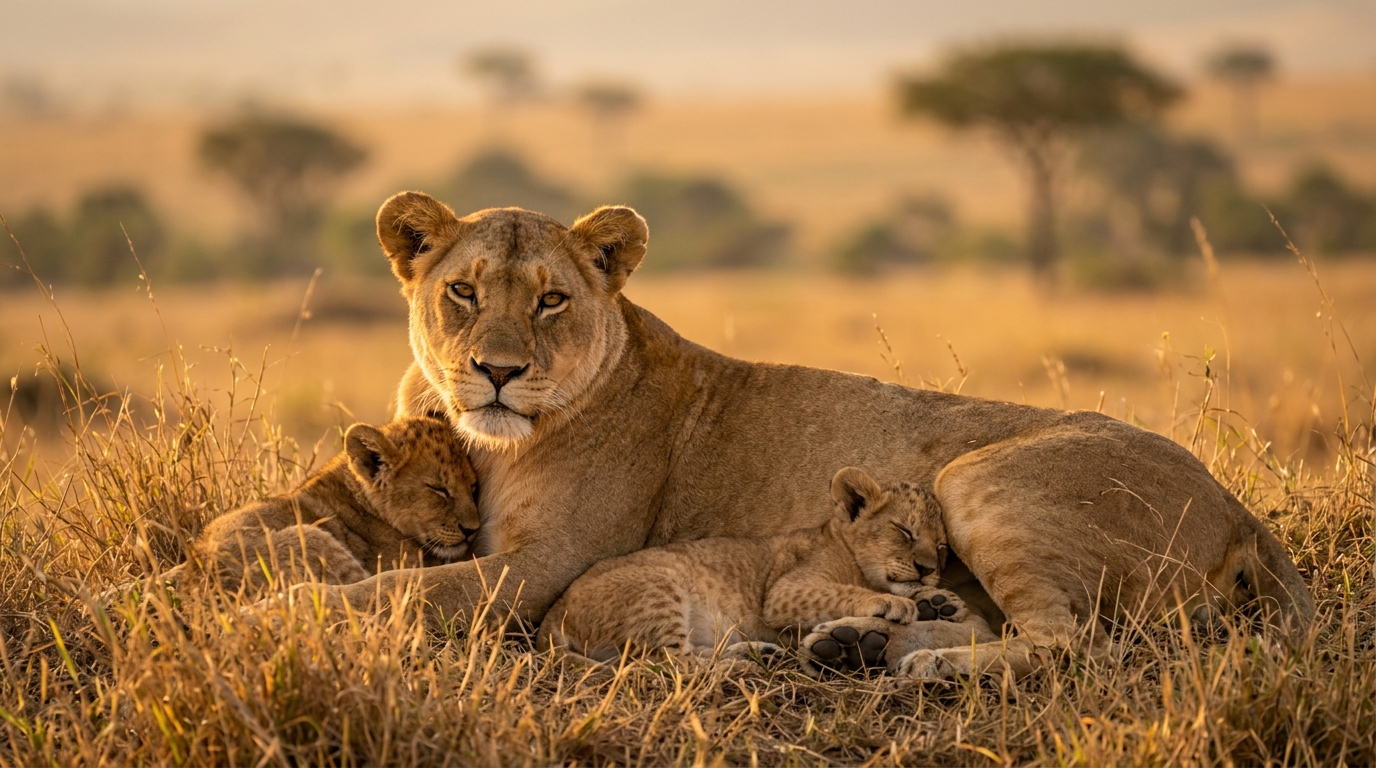
On safari, guide quality is the strongest driver of satisfaction researchers have measured — and it's bookable, if someone asks: guides can be requested by name or profile (Kenya's KPSGA Gold, southern Africa's FGASA hour ladders), briefed on your kids before arrival, and paired with a private vehicle. Camp choice is the other half: child policies, guide-team depth, and satphone-only remoteness all live in unwritten, human-held knowledge.
Here is a scene we think about constantly. Two open-sided Land Cruisers, same make, same park, parked at the same lion sighting at 6:40 in the morning. In one, a guide is reading the pride's body language aloud — which lioness is hunting lead, why the cubs are agitated, what the topi on the ridge already know — and a nine-year-old is so locked in she's forgotten the iPad exists. In the other vehicle, someone announces “lions,” and eleven minutes later everyone is asking about breakfast.
Same park. Same animals. Same nightly rate. Two entirely different trips.
En Route Truth: On safari, the guide isn’t part of the experience. The guide is the instrument the entire experience plays through — and guide quality is the least visible line on any itinerary.
Guiding is a credentialed craft, measured in years and hours
The safari world takes this seriously enough to have built formal ladders. In Kenya, the professional guides' association certifies Bronze, then Silver, then Gold — each step requiring a minimum of three more years in the field, with Gold earned through a three-day live assessment. Gold guides are, in the association's own words, among the best guides in Kenya; one Governors' Camp guide reached Gold across a sixteen-year career. Southern Africa logs it in hours: a Professional Field Guide qualification requires 520 logged field days; the top dangerous-game walking credential demands 1,200 hours behind the rifle and 600 assessed encounters with dangerous game. These aren't marketing badges. They're flight hours.
And the evidence says it's decisive. A Kenyatta University study of 311 travelers staying around the Masai Mara found guiding competency to be the strongest of the satisfaction drivers it measured — stronger than the vehicle, stronger than anything else they tested. One of southern Africa's veteran operators has kept the same sentence at the top of its advice page since 2014: “The quality of your safari guide is the most important influence on the overall quality and enjoyment of your safari.” Every specialist we respect says a version of the same thing.
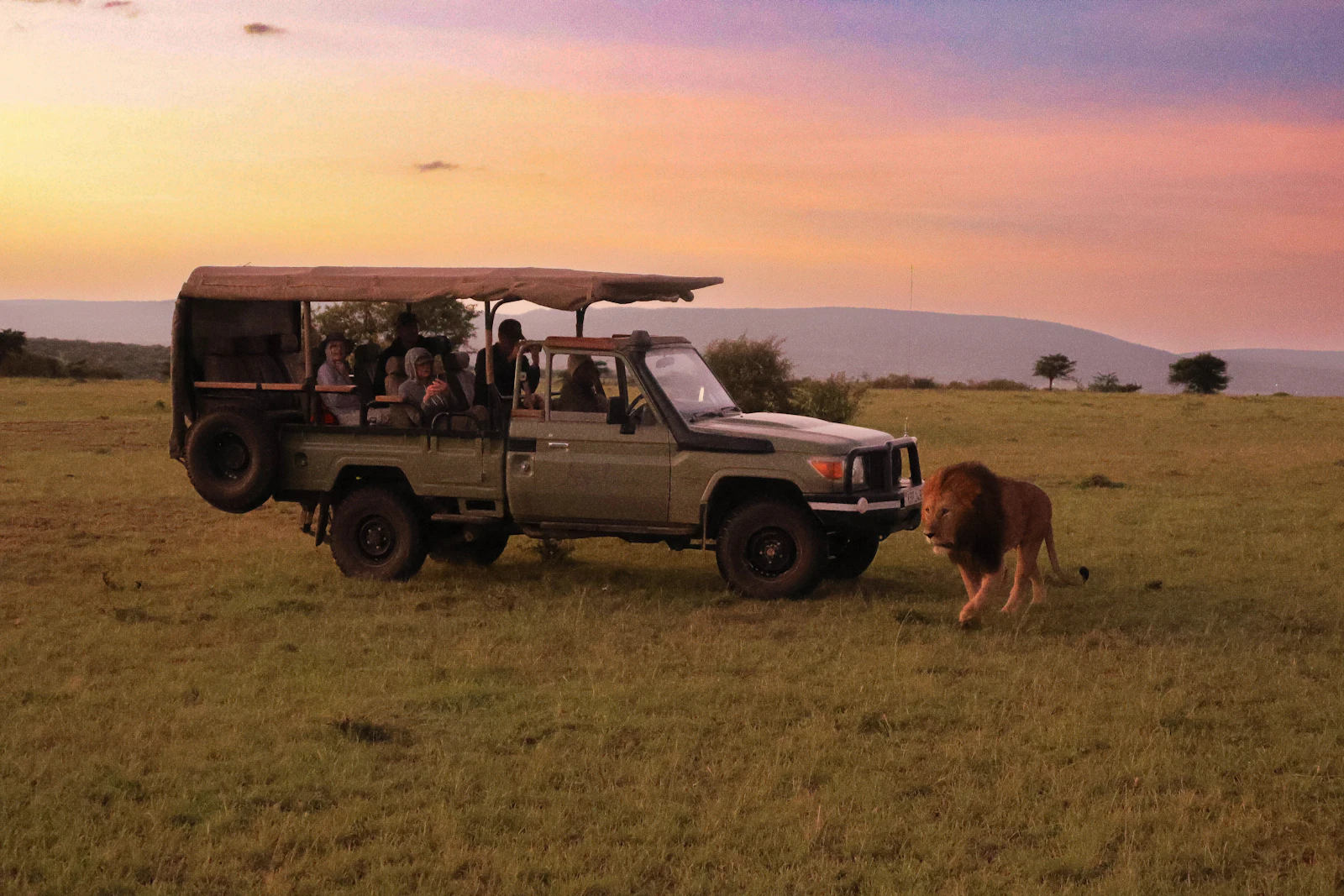
What this means when someone books your trip
- Guides can be requested. Camps assign guides on rotation unless someone asks. We ask — by name where we know them, by profile where we don't: a Gold-level or senior guide, one who's great with kids, a birding specialist, a photographer who understands light and angles.
- The private vehicle is often the whole decision. A shared vehicle means shared priorities and a fixed schedule. A private one means your nine-year-old's attention span sets the rhythm — and at many camps it's what makes a young family bookable at all.
- The briefing goes both ways. A great guide with no context is running blind. Before arrival, ours know the kids' ages and obsessions, who's nervous, who's shot film before, and what this trip is supposed to mean. That one email changes the first game drive.
- Tipping is a judgment system, not an afterthought. Guide base pay is modest; gratuities are a meaningful share of take-home earnings, with operator guidance around $10–20 per guest per day for guides, plus a separate shared pool for camp staff. A ten-day safari involves a few hundred dollars of decisions — we brief exactly how, when, and in what currency, so it never becomes an awkward last-morning scramble.
The camp is the other half of the same secret
Guide intelligence and camp intelligence are the same category of knowledge: unwritten, current, and human-held. Which camps have no wifi and no cell signal — satellite phone only — so someone outside the bush needs to hold your whole trip while you're inside it. Which camps take children at which ages, and which will only do so with that private vehicle. Whose guiding team is deep, and whose star guide just moved camps this season — the fact that never appears on a website. The serious operators run 24/7 duty offices with pre-built emergency plans for exactly this reason; when the Mara flooded in 2024, that human chain evacuated every traveler safely. None of it is on the booking page.
You can't interview a guide through a chatbot, and a booking engine will never tell you the guide team changed. This is relationship inventory — collected in camp, over years, on the ground. It's the part of the trip you can't screenshot, and it's the part that decides whether your family comes home changed or just tanned.
Planning a safari — or holding a draft of one? Send it over. We'll tell you what the itinerary can't: whether the camps fit your kids, whether the vehicles are right, and where the guide request should go.
Fair Questions
Can you request a specific safari guide?
Yes — camps assign guides on rotation unless someone asks. Guides can be requested by name where known, or by profile: a senior or Gold-level guide, one who's great with kids, a birding or photography specialist. The request has to happen at booking, not at check-in.
How much do you tip on safari?
Operator guidance runs around $10–20 per guest per day for your guide, with a separate shared pool for camp staff — and it matters, because gratuities are a meaningful share of a guide's earnings. We brief clients on exactly how, when, and in what currency before they fly.